Description
Key Specifications & Architecture
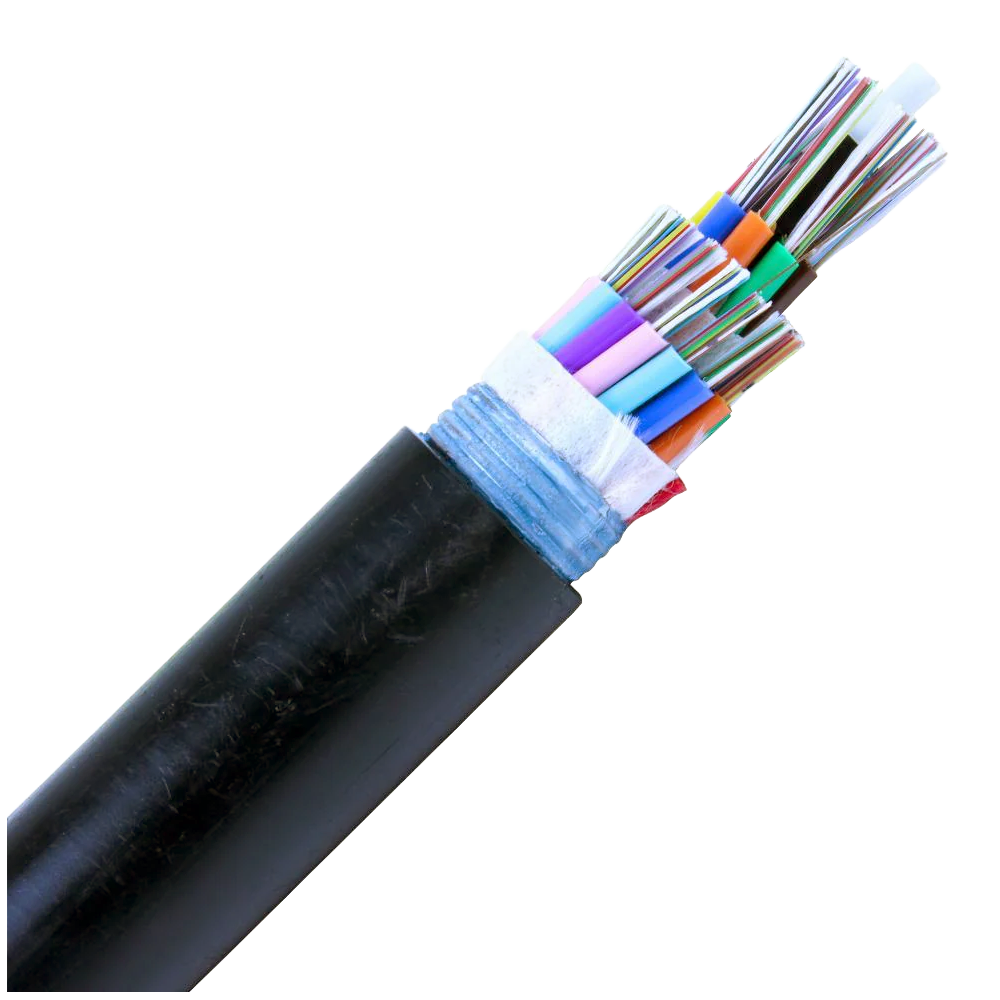
- Fiber Count: 144 fibers, organized in a Multi-Loose Tube (LT) design.
- Tube Construction: Typically structured as 12 loose tubes, each containing 12 color-coded fibers for easy identification and splicing.
- NASJ Designation: Non-Armored Single Jacket (NASJ). This indicates an all-dielectric construction, meaning it does not contain metallic components or corrugated steel armoring. It relies on internal fiberglass yarns or central strength members for tensile resilience.
- Fiber Type: Standardized with Single-Mode G.652.D optical fibers, optimized for low attenuation across long-haul transmission networks.
- Water Blocking: Employs a thixotropic gel inside the tubes or water-swellable materials to prevent moisture and water ingress.
- Outer Jacket: Wrapped in a heavy-duty, UV-resistant High-Density Polyethylene (HDPE) or Medium-Density Polyethylene (MDPE) outer jacket designed to endure severe environmental stress.
Primary Applications
- Duct and Conduit Installations: The all-dielectric, friction-reducing jacket allows it to be smoothly pulled or blown through underground telecommunication ducts.
- Lashed Aerial: Suitable for hanging on utility poles when lashed to an external messenger wire.
- Campus Backbones: Ideal for linking multi-building networks where high fiber density and lightning immunity (due to its metal-free design) are required